
General Professional Equine Practitioner (GPEP Training System) Ver 1.1

A Comprehensive, Practical and International Clinical Training Program for Equine Veterinarians
- Course Overview
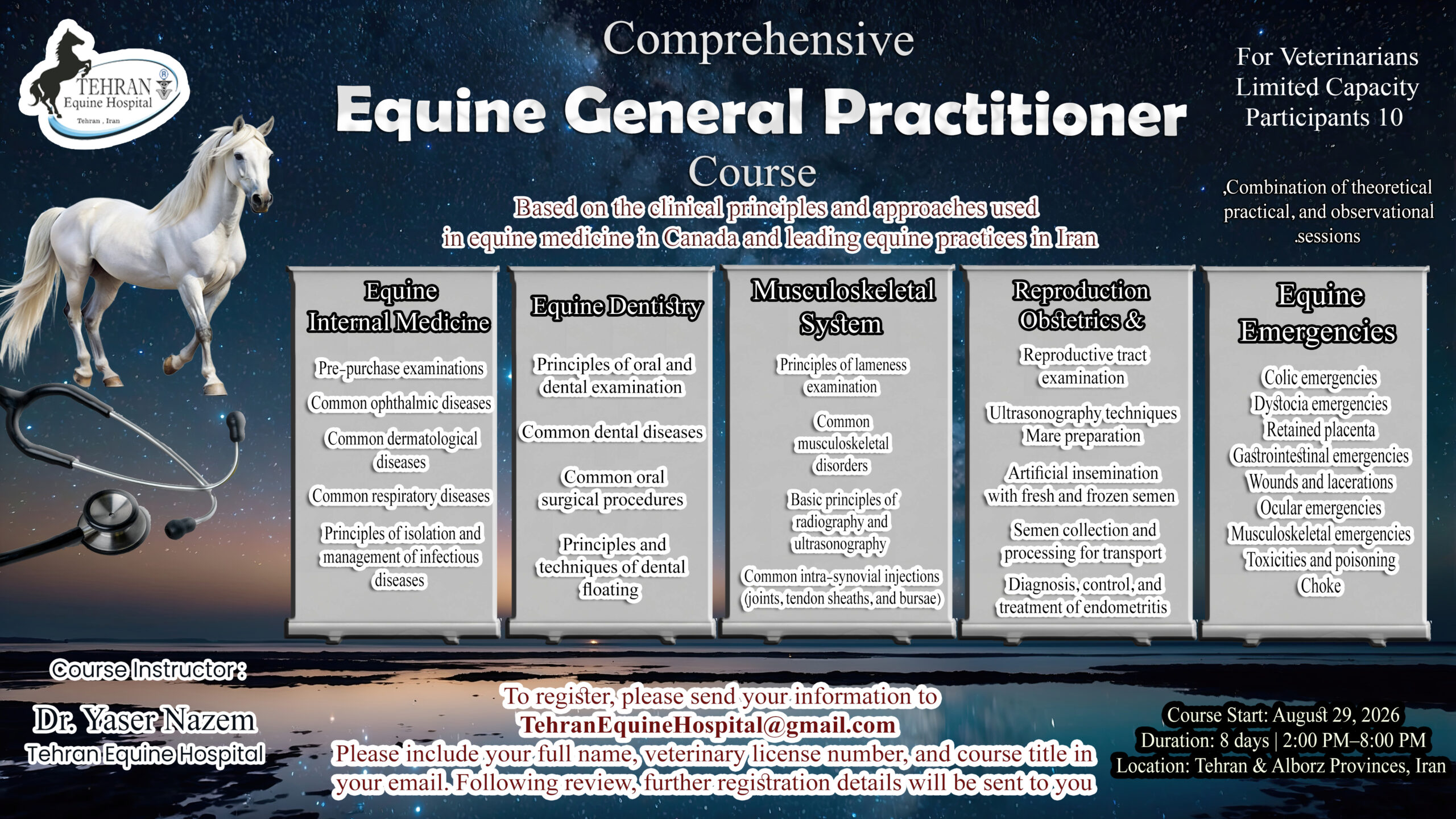
General Professional Equine Practitioner (GPEP) is a comprehensive, integrated, practice-oriented and internationally focused educational program in Equine Medicine, designed to enhance the clinical capabilities of veterinarians working with horses and to develop highly competent, confident and professionally independent Equine General Practitioners.
The program is designed around clinical principles and approaches commonly applied in Canada and other leading countries in veterinary medicine and the equine industry. It aims to integrate scientific knowledge, clinical experience, practical skills and professional decision-making into a structured and coherent educational pathway.
The primary goal of the program is to train veterinarians who can evaluate, diagnose, stabilize and treat a broad range of common and important equine conditions in real-world Clinic, Hospital and, particularly, Field Practice settings, while recognizing when timely Referral is required.
GPEP is not simply a collection of separate subjects in Surgery, Reproduction, Lameness, Internal Medicine, Dentistry, Ophthalmology and Emergency Medicine. Rather, it connects these disciplines within a unified clinical framework for the assessment and management of the equine patient.
- Educational Philosophy and Rationale
In traditional Equine Medicine education, different disciplines are often taught separately and in considerable depth, including:
• Surgery
• Lameness and Equine Sports Medicine
• Reproduction
• Internal Medicine
• Dentistry
• Ophthalmology
• Emergency Medicine
• Infectious Diseases
This approach is essential for developing specialists in individual disciplines. However, it is not always sufficient for developing a General Practitioner who must manage patients comprehensively in real-world Practice.
As a result, a veterinarian may become highly competent in one particular discipline while having less confidence or experience in other areas that are essential to General Practice.
This challenge is particularly important in Equine Medicine because a substantial proportion of equine veterinary services are delivered in:
Farms, Stables, Equestrian Clubs, Breeding Facilities, Competition Venues and other Field Practice environments.
In these settings, veterinarians may encounter patients with multiple systems involved simultaneously, while access to advanced diagnostic equipment, immediate specialist consultation or rapid hospital Referral may be limited.
A professional Practitioner must be able to:
See the patient → Define the problem → Establish priorities → Develop Differential Diagnoses → Make diagnostic decisions → Stabilize the patient → Initiate treatment → Monitor the patient → Recognize the appropriate time for Referral.
Therefore, the central objective of GPEP is to organize fragmented veterinary knowledge into a coherent framework of Structured Clinical Thinking.
In other words:
Scattered Knowledge → Structured Clinical Thinking → Practical Decision-Making
- How GPEP Differs from Traditional Academic Education
GPEP is not a conventional university-style course focused on repeating basic subjects, pure pathophysiology, disease mechanisms or memorization of disease classifications.
The program assumes that participants already possess fundamental veterinary knowledge.
The central question of the course is:
“When you are faced with a real case, how should you think and what should you do?”
Training begins with Clinical Presentation, Clinical Signs, examination findings, the owner’s concerns and the Problem List, and progresses through:
Differential Diagnosis → Diagnostic Selection → Interpretation of Findings → Treatment Decision → Monitoring → Prognosis → Referral
The principal educational pathway is:
Clinical Presentation → Clinical Reasoning → Diagnosis → Decision → Treatment → Outcome
rather than:
Pathophysiology → Disease Classification → Memorization
The objective is to transform the scientific knowledge already possessed by the veterinarian into knowledge that can be effectively applied in real-world Practice.
- A Major Strength of the Program: Clinical Diagnostic & Management Charts
One of the most distinctive features of GPEP is the use of a comprehensive collection of Clinical Diagnostic & Management Charts.
These charts are structured clinical algorithms designed to guide the veterinarian from the first presenting sign or complaint through:
Initial Assessment → Diagnosis → Immediate Actions → Treatment → Monitoring → Referral
The charts are not simply summaries of textbooks or translations of existing guidelines. They represent an integration of:
• International scientific knowledge and authoritative references
• Professional guidelines
• Evidence-Based Veterinary Medicine
• Direct clinical experience of the instructor
• More than 15 years of Private Equine Practice
• Extensive exposure to real-world Cases
• Clinical decision-making under real Field and Hospital Practice conditions
An important feature of these charts is the incorporation of Alternative Pathways.
This means that when a veterinarian working in the field does not have access to advanced diagnostic equipment such as digital Radiography or advanced Ultrasonography, the chart provides alternative approaches based on:
• Detailed History Taking
• Physical Examination
• Basic diagnostic tools
• Diagnostic Reasoning
• Available clinical findings
to reach the most appropriate diagnostic and therapeutic decision.
For example, instead of simply learning a list of respiratory diseases, participants learn to approach the case systematically:
The horse presents with these clinical signs → What questions should I ask? → What should I look for during the examination? → What are my Differential Diagnoses? → Which diagnostic test provides the greatest clinical value? → How will the result change my decision? → What treatment should I initiate? → When is Referral required?
The same system is applied to:
• Colic
• Lameness
• Respiratory disease
• Reproductive disorders
• Ophthalmic disease
• Neonatal emergencies
• Wounds
• Internal Medicine
• And other major Equine Practice problems
The ultimate goal is for participants to leave the course not simply having memorized a collection of diseases, but possessing a practical set of Clinical Roadmaps that can be used directly in real-world Practice.
- The Distinctive and Engaging Component: “Hi, Dr!”
One of the most distinctive components of GPEP is the “Hi, Dr!” section.
In this component, education moves beyond theoretical instruction and places participants inside a realistic Practice scenario.
The scenario begins with a phone call from the owner:
“Hi, Dr! My horse has a problem…”
From that moment, the instructor and participants follow the complete workflow of an Equine Practitioner step by step.
The Complete Scenario
Owner’s Phone Call
↓
Initial Screening & Triage
↓
Decision to Attend
↓
Arrival & First Assessment
↓
History Taking
↓
Physical Examination
↓
Problem List
↓
Differential Diagnosis
↓
Diagnostic Plan – Field vs. Hospital
↓
Interpretation of Findings
↓
Emergency Stabilization
↓
Treatment Execution
↓
Client & Groom Communication
↓
Follow-up & Reassessment
↓
Prognosis
↓
Final Outcome
At every stage, participants are confronted with a key question:
“What would you do next?”
The objective is not simply to provide the correct answer, but to teach participants how a professional Practitioner thinks.
For example:
• What questions should be asked during the initial phone call?
• Is this case truly an emergency?
• What equipment and medications should be taken to the location?
• What should be the first action upon arrival?
• Which findings are most important?
• How should the Differential Diagnosis be developed?
• Which diagnostic test provides the greatest clinical value?
• What is the most appropriate decision under Field Practice limitations?
• What treatment should be initiated immediately?
• When should the patient be referred to a Hospital?
• How should Prognosis be explained to the owner?
• How should treatment and care instructions be communicated to the Groom or Caretaker?
• And ultimately, what will be the outcome of the case?
In this section, the Clinical Diagnostic & Management Charts are applied in real time.
Participants therefore do not simply see a chart—they learn how to use it to manage an actual clinical case.
An important component of “Hi, Dr!” is Client Communication. This includes communication not only with owners and trainers, but also with Grooms/Syces, for whom English may be a second language in many equine environments.
Participants learn how to communicate medication, nursing and monitoring instructions clearly and practically, thereby improving the likelihood of correct implementation.
“Hi, Dr!” is the point at which all major elements of the course converge within a single Clinical Case:
Scientific Knowledge + Clinical Experience + Clinical Reasoning + Clinical Charts + Decision-Making + Treatment + Client Communication
The ultimate objective is to simulate, as realistically as possible, the experience of a working day as an Equine Practitioner:
From “Hi, Dr!” to the final outcome of the case.
- Scientific and Professional Foundation
The educational content of GPEP is built on three principal pillars.
A. International Reference Textbooks
Including:
• Equine Internal Medicine – Reed, Bayly & Sellon
• Adams and Stashak’s Lameness in Horses
• Equine Surgery – Auer, Stick & Kümmerle
• Equine Reproduction – McKinnon et al.
• Authoritative Equine Dentistry references
• Equine Emergency and Critical Care references
• Equine Sports Medicine references
• Diagnostic Imaging references
• And other recognized specialist resources
B. Professional Guidelines and Standards
Including:
• American Association of Equine Practitioners (AAEP)
• British Equine Veterinary Association (BEVA)
• Principles of Evidence-Based Veterinary Medicine
• Common standards applied in advanced Equine Hospitals and Equine Practices
• Standard Operating Procedures (SOPs) used in professional veterinary environments
• SOPs applied in advanced veterinary centers in Canada
C. Direct Clinical Experience
The program is based on more than 15 years of direct experience in Private Equine Practice, involving a broad range of Cases in:
• Equine Surgery
• Colic Surgery
• Reproduction
• Advanced Reproductive Technologies
• Lameness
• Internal Medicine
• Emergency Medicine
• Ophthalmology
• Dentistry
• Hospital Management
• Field Practice
as well as more than one year of Clinical Mentorship and Advanced Clinical Training in Canada.
The objective is not simply to transfer scientific information, but to transform scientific knowledge and clinical experience into Clinical Decision-Making that can be applied in real-world Practice.
- Learning Objectives
By the end of the program, participants will be able to: - Perform a systematic and professional equine examination and develop a Problem List and Differential Diagnosis.
- Rapidly identify, triage and prioritize emergency cases and initiate appropriate Stabilization.
- Evaluate and manage common cases of Internal Medicine.
- Apply an appropriate clinical approach to the Febrile Horse and cases of FUO.
- Recognize and initiate management of endemic, quarantine and transboundary infectious diseases relevant to the region.
- Perform a systematic Lameness Examination.
- Perform Diagnostic Analgesia, including nerve and joint blocks, using appropriate techniques.
- Use Radiography and Ultrasonography at Field and Clinic level and interpret clinically relevant findings.
- Perform common Intra-articular, Tendon Sheath and Bursa injections using appropriate technique and aseptic principles.
- Evaluate common pathologies affecting joints, tendons, ligaments and synovial structures.
- Prepare mares for breeding and perform Artificial Insemination (AI) using fresh, cooled and frozen semen.
- Evaluate, process and prepare semen for transport.
- Diagnose and manage Endometritis and other common reproductive disorders.
- Evaluate common reproductive disorders of stallions and perform safe sample collection.
- Recognize and provide initial management of common diseases affecting the teeth, eyes, skin, heart and respiratory system.
- Perform common dental examinations and procedures and recognize cases requiring Referral.
- Recognize ophthalmic emergencies and important ocular diseases and initiate appropriate treatment.
- Perform selected common Field Surgery procedures with appropriate aseptic technique and case selection.
- Evaluate wounds and Lacerations and repair appropriate cases.
- Stabilize fractures and limb injuries in the field and prepare patients for safe transport.
- Evaluate a healthy neonate and recognize and initially manage important Neonatal Foal Emergencies.
- Evaluate and provide initial management of Neonatal Sepsis, Failure of Passive Transfer, Meconium Impaction, HIE, Respiratory Distress, Prematurity, Neonatal Isoerythrolysis, Umbilical Infection, Septic Arthritis and Uroperitoneum.
- Apply Fluid Therapy and practical electrolyte management in Field and emergency situations.
- Apply principles of clinical pharmacology and rational use of medications and antibiotics.
- Use Clinical Diagnostic & Management Charts for structured clinical decision-making.
- Lead the complete case-management process in real-world Practice, from the owner’s initial contact through Follow-up and Outcome.
- Consult with Specialists when appropriate and recognize the appropriate time for Referral.
- Integrate multiple findings within a single Clinical Case and make coherent, evidence-informed clinical decisions.
- Prerequisites
The course is designed for veterinarians who possess a veterinary degree and an appropriate foundation in:
• Anatomy
• Physiology
• Basic Equine Examination
• Basic Pharmacology
• Basic Principles of Surgery
GPEP is not designed to teach the fundamentals of veterinary medicine. Its purpose is to elevate existing knowledge and skills toward the level of Professional Equine General Practice.
- Optimized Course Structure – Hybrid Model
To maximize efficiency and flexibility and facilitate participation by working veterinarians, particularly those practicing in different countries, the program is designed as a Hybrid Model. - Theoretical and Chart-Based Learning – Online / Remote
Suggested duration: 80 hours
Structured as:
10 Training Days × 8 Hours per Day
This component may be delivered through live classes, interactive sessions and/or high-quality recorded lectures.
The focus will be on:
• Essential scientific foundations
• Structured Clinical Lectures
• Clinical Diagnostic & Management Charts
• Case-Based Learning
• Clinical Reasoning
• Mastery of the course subjects
• Theoretical Case Review
• Preparation for the practical component - Practical Training and Skills Workshops – In Person
Suggested duration: 5 days of practical training
The exact structure may be adapted according to:
• Host facility capabilities
• Number of participants
• Availability of horses
• Diagnostic equipment
• Hospital or Clinic facilities
The practical component follows:
Demonstration → Hands-on Practice → Supervised Clinical Application
Training may include work with live horses, diagnostic techniques, Diagnostic Analgesia, Diagnostic Imaging, injections, Reproduction, Field Surgery, Emergency Scenarios and “Hi, Dr!” simulations.
- Teaching Methodology
GPEP is not a purely Lecture-Based course. It is highly interactive and based on Active Learning.
Teaching methods include:
• Structured Clinical Lectures & Hybrid Delivery
• Case-Based Learning
• Live Case Discussions
• Clinical Diagnostic & Management Charts
• Clinical Decision-Making
• Interactive “Hi, Dr!” Simulations
• Demonstration → Practice → Feedback
• Hands-on Wet Labs
• Supervised Clinical Application
• Problem-Solving
• Emergency Scenarios
• Diagnostic Imaging Interpretation Workshops
• Owner Communication Scenarios
• Clinical Integration
The fundamental principle of the course is that participants should not only learn:
“What is the disease?”
but should be able to answer:
“What do I do now?”
- Detailed Course Curriculum
A. Equine Emergency & Environmental Medicine
Emergency and Environmental Medicine
• Systematic triage of the emergency equine patient in the field
• Emergency Approach to the Equine Patient
• Gastrointestinal emergencies and clinical decision-making in Colic
• Field versus Referral protocols in Colic
• Differentiation and management of Strangulating and Non-strangulating Colic
• Field Stabilization of obstructive and non-obstructive Colic
• Emergency management of Choke and esophageal obstruction
• Wounds and Lacerations as common Field emergencies
• Acute limb injuries, fractures and Emergency Splinting
• Toxicities and Poisoning
• Acute respiratory emergencies
• Obstetrical emergencies including Dystocia, Premature Placental Separation / Red Bag and Retained Placenta
• Postpartum emergencies
• Emergencies associated with stallions during breeding and semen collection
• Stallion Breeding Emergencies including Paraphimosis, Haemospermia and related conditions
• Ophthalmic emergencies and acute corneal trauma
• Neonatal Foal Emergencies
• Environmental Medicine and Heat Stress, particularly under Middle Eastern conditions
• Electrolyte Disorders
• Heat Stroke
• Exhausted Horse Syndrome in Endurance Competition
• Management of Anhidrosis / Dry Coat
• Clinical decision-making and logistics of Emergency Referral
B. Equine Internal Medicine & Infectious Diseases
Internal Medicine and Endemic Infectious Diseases
• Systematic Physical Examination of the horse
• Systematic Physical Examination
• Clinical approach to the Febrile Horse
• Management of Fever of Unknown Origin (FUO)
• Practical Fluid Therapy in the field
• Electrolyte calculations
• Principles of Clinical Pharmacology
• Rational antibiotic use
• Common respiratory diseases including Asthma and Infectious Pleuropneumonia
• Common gastrointestinal diseases
• Common cardiac diseases
• Neurological diseases
• Dermatological diseases
• Common ophthalmic diseases
• Isolation and Biosecurity
• Infectious Disease Management
• Regional endemic, quarantine and transboundary infectious diseases, including:
o Equine Piroplasmosis – Babesia caballi & Theileria equi
o Glanders
o African Horse Sickness (AHS)
o Surra – Trypanosoma evansi
o Epizootic Lymphangitis
o Strangles
• Emphasis on zoonotic considerations and public-health requirements associated with relevant diseases
• Regional quarantine protocols
• Biosecurity protocols for quarantines, equestrian clubs, breeding facilities and international competitions
• Pre-Purchase Examination (PPE)
C. Equine Dentistry
Practical Equine Dentistry
• Applied anatomy of the oral cavity and teeth
• Equine Dental Anatomy
• Comprehensive oral and dental examination using modern instruments
• Common dental pathologies in sport and older horses
• Principles and techniques of dental floating:
o Manual Floating
o Power Floating
• Field Dental Radiography
• Interpretation of dental Radiographs
• Principles of minor oral surgery
• Extraction of incisors and Wolf Teeth in appropriate cases
• Management of selected common oral disorders
• Recognition of cases requiring Referral for advanced maxillofacial and dental surgery
D. Equine Lameness & Sports Medicine
Lameness and Equine Sports Medicine
• Systematic and dynamic Lameness Examination
• Evaluation of horses on different surfaces
• Static and Dynamic Evaluation
• Principles and techniques of nerve blocks and Diagnostic Analgesia
• Common Disorders of the Forelimb and Hindlimb
• Sport-related injuries specific to Endurance Competition
• Sport-related injuries in Flat Racing
• Clinical and metabolic evaluation of endurance horses at Vet Gates
• Basic Diagnostic Imaging
• Principles of limb Radiography
• Basic Radiographic Interpretation
• Tendon and ligament Ultrasonography in the field
• Basic Musculoskeletal Ultrasonography
• Pathology of synovial structures:
o Joints
o Tendon Sheaths
o Bursae
• Intra-articular injections
• Tendon Sheath injections
• Bursa injections
• Principles of intra-articular medications:
o Corticosteroids
o Hyaluronic Acid
o Regenerative Medicine
• Tendon and ligament injuries
• Common Soft Tissue Injuries
• Rehabilitation and adjunctive treatment modalities:
o Shockwave
o Laser
o Mesotherapy
• Principles of Rehabilitation
• Referral criteria for advanced Lameness cases
E. Equine Reproduction & Theriogenology
Reproduction and Advanced Reproductive Technologies
• Systematic examination of the mare reproductive tract
• Ultrasonographic monitoring of the Estrous Cycle
• Reproductive Ultrasonography
• Estrous Cycle Management
• Preparation of mares for breeding
• Artificial Insemination (AI) using:
o Fresh Semen
o Cooled Semen
o Frozen Semen
• Laboratory semen evaluation and management
• Semen Collection
• Semen Evaluation
• Semen Processing
• Preparation of semen for Transport
• Endometritis:
o Diagnosis
o Pathophysiology
o Management and treatment protocols
• Pregnancy diagnosis
• Twin pregnancy management
• Management of common reproductive disorders
• Monitoring of high-risk pregnant mares
• Initial management of breeding stallions
• Safe stallion sample collection
• Advanced Reproductive Technologies:
o Embryo Transfer (ET)
o Recipient Mare Management
• Principles of ET application in the Sport and Show Horse Industry, particularly in the Middle Eastern market
• Semen Handling and Management under Field and Breeding Facility conditions
F. Equine Surgery & Field Surgery
Field Surgery and Wound Management
• Principles of Equine Sedation
• Field Anesthesia
• Principles of short-duration General Anesthesia under appropriate conditions
• Triple Drip and principles of its safe use in relevant situations
• Principles of Asepsis and surgical preparation under farm conditions
• Surgical Preparation
• Management of open wounds
• Skin lacerations
• Laceration Repair
• Common Field Surgical Procedures
• Castration using different techniques and management of complications
• Simple Umbilical Hernia Repair
• Management of common soft-tissue conditions amenable to Field treatment
• Management of simple mandibular and dental alveolar fractures
• Common Mandibular/Maxillary and Alveolar Fractures
• Principles of initial limb fracture stabilization
• Appropriate case selection for Field Surgery
• Referral criteria for cases requiring advanced surgical management
G. Equine Ophthalmology
Equine Ophthalmology
• Systematic ocular examination
• Field ophthalmic diagnostic equipment and techniques
• Basic Ophthalmic Diagnostics
• Common corneal diseases
• Corneal Ulceration
• Medical treatment and management of corneal ulcers
• Placement of a Subpalpebral Lavage System (SPL)
• Uveitis and Equine Recurrent Uveitis (ERU)
• Differential diagnosis of Uveitis
• Ophthalmic emergencies
• Eyelid and orbital injuries
• Specific ophthalmic medical therapies
• Recognition of cases requiring Referral for surgical or advanced ophthalmic treatment
H. Neonatal Foal & Periparturient Medicine
Neonatal Medicine and Periparturient Care
• Evaluation of the mare and foal during parturition
• Normal Parturition
• Assessment of the normal neonate
• Critical behavioral and physiological milestones during the first hours after birth
• Dystocia
• Red Bag Emergency
• Retained Placenta
• Neonatal Sepsis
• Failure of Passive Transfer (FPT)
• Meconium Impaction
• Neonatal intestinal obstruction
• Neonatal Encephalopathy / HIE
• Neonatal Respiratory Distress
• Prematurity and Dysmaturity
• Neonatal Isoerythrolysis
• Umbilical Infections
• Septic Arthritis
• Uroperitoneum
• Neonatal Diarrhea
• Fluid Therapy
• Critical Care of the critically ill and emergency foal
- Clinical Integration
One of the primary objectives of GPEP is to develop the ability to achieve Clinical Integration.
At this stage, knowledge acquired from different disciplines is integrated through the management of realistic Clinical Cases.
Cases are not taught merely as isolated diseases. Instead, participants are expected to follow the complete patient journey:
History → Physical Examination → Problem List → Differential Diagnosis → Diagnostic Plan → Stabilization → Treatment → Monitoring → Prognosis → Referral → Outcome
This approach allows participants to practice clinical reasoning, prioritization and professional decision-making, rather than simply memorizing a collection of diseases.
In this section, Clinical Charts and “Hi, Dr!” scenarios are used together so that participants can apply their scientific knowledge and practical skills within a realistic Clinical Case.
The goal is for the veterinarian to be capable of leading the entire treatment process—from arriving at the stable through recovery, Follow-up or Referral.
- Professional Outcomes for Participants
The goal of GPEP is not to create a Specialist within a short period of time. Rather, it is designed to develop a strong, comprehensive and dependable Equine General Practitioner with a solid clinical foundation.
Following successful completion of the program, participants will be better prepared to: - Practice as an Equine General Practitioner in appropriate Practice environments with increased clinical confidence.
- Properly assess cases and develop a structured Problem List.
- Rapidly identify and Stabilize emergency patients.
- Diagnose and provide initial treatment for common conditions.
- Select appropriate diagnostic procedures.
- Use Clinical Diagnostic & Management Charts for systematic decision-making.
- Perform common clinical techniques to an appropriate professional standard.
- Monitor and Follow-up patients.
- Communicate professionally with owners, trainers and Grooms.
- Consult Specialists when necessary.
- Recognize the appropriate time for Referral.
- Use rational clinical decision-making to avoid unnecessary diagnostic tests and procedures and, where possible, optimize the owner’s diagnostic and treatment costs.
- Develop stronger professional capabilities in the international equine markets of the Middle East and Asia through familiarity with regional diseases, environmental conditions and the practical needs of Equine Practice.
- Develop an international professional network with Clinicians and Referral Centers for Consultation and Referral.
- Professional Pathway After the Course
GPEP is not the endpoint of professional education; rather, it can serve as the beginning of a focused pathway toward advanced specialization.
After establishing a strong foundation in General Practice, veterinarians may pursue further specialization according to their interests, abilities and professional needs in areas such as:
• Equine Surgery
• Equine Internal Medicine
• Equine Reproduction
• Equine Sports Medicine
• Equine Lameness
• Equine Emergency & Critical Care
• Equine Dentistry
• Equine Ophthalmology
Thus, GPEP serves as a bridge between:
General Equine Practice → Advanced Equine Specialization
- International Approach and Program Development
Because the specialized educational materials, Clinical Charts, key terminology, Case Discussions and Clinical Communication used throughout the program are delivered in English, GPEP has strong potential to be developed as a standardized regional and international educational model.
GPEP is not limited to a particular country or veterinary system. Instead, it aims to provide transferable Best Practices in Equine Practice within a common educational framework.
Collaboration with:
• Veterinary Universities
• Equine Hospitals
• Equine Clinics
• Research Centers
• Equestrian Federations
• Breeding Facilities
• Professional Training Centers
in different countries may provide opportunities to develop the program through various formats, including:
• Joint Equine Training Programs
• Clinical Workshops
• Advanced Equine Courses
• Clinical Observerships
• Continuing Professional Development (CPD)
• International Clinical Exchange
• Collaborative Research
• Case-Based Online Education
This structure has the potential to develop GPEP beyond a single educational course into an international educational and professional network in Equine Medicine.
- The GPEP Vision
The ultimate vision of GPEP is to establish an:
International Equine General Practice Training Model
A model capable of bringing together:
Scientific Knowledge + Clinical Experience + Clinical Thinking + Professional Decision-Making + Practical Skills + Client Communication
within a single educational framework for Equine Veterinarians.
The ultimate goal is not simply for veterinarians to possess more information after completing the program.
The goal is for them to:
See the patient better, think better, make better decisions and provide better treatment.
GPEP aims to take veterinarians from:
Scattered Knowledge
to:
Structured Clinical Thinking
and from there to:
Practical Decision-Making.
Ultimately:
The ultimate goal is not simply to teach more equine medicine, but to teach veterinarians how to practice equine medicine as complete, confident and clinically competent professionals.
The philosophy of the program can be summarized in one sentence:
From Knowledge to Clinical Thinking — From “Hi, Dr!” to the Final Outcome.
Dr Yaser Nazem
Tehran Equine Hospital